The Story of my Broken Leg, The Recovery, the frustrations and how it shaped what I do 20 years later.
20 Years On: The Story of My Broken Leg
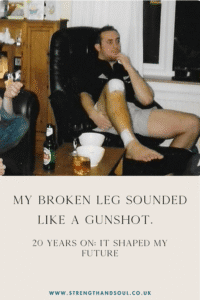
As it is the 20th anniversary of my broken leg, I thought I’d share a bit of the story.
On the 12th of November 2005, I’d been dropped to the second team after being miles off the pace against Ellon the week before. I’d been out most of the previous season due to an injury called osteitis pubis and was working hard to get back to fitness. I thought I was there or thereabouts, but the Ellon game proved otherwise.
So, I lined up at outside centre for the 2nds against Biggar 2nds. I felt good — playing pretty well and enjoying it. The ball went out on the far touchline, and I ran over to the sideline to see if I could borrow a shin guard. I’m not sure why — I’d never worn them — but I’d taken a knock on my shin and thought a bit of extra protection would help. No one on the sideline had one, so I jogged back into position for the line-out.
Like a Gunshot
Biggar won their line-out and went wide straight away. I was tracking across to tackle my man when bang! Our winger came in to make the tackle, his legs spun round, and he hit my right shin. Apparently, it sounded like a gun going off. People had to look away. I just felt pain — something wasn’t right. When you’ve got broken leg, you know.
Luckily, a paramedic was playing for our team. I remember him pulling down my sock, then immediately pulling it back up again.
The ambulance arrived. I don’t remember much of the journey, but I do remember our bar steward at the time — and rugby mum to a lot of the boys — Carole, being there for support. The paramedic asked why I’d stopped taking the gas and air; and then realised it was empty. “That does us for three pregnant women,” she said.
When I got to the Royal in Edinburgh, my parents and Jo weren’t far behind — at least that’s how I remember it. By that point, I was morphined up to the max. Apparently, I wasn’t happy about missing the 60s night at the rugby club. I just remembered a friend calling to ask if he could borrow my Sergeant Pepper outfit!
Just as Well Google Didn’t Exist
X-rays showed I had a broken leg , both my tibia and fibula — and potentially, the fibula had already fractured before I’d asked for the shin guard. I was told I’d be in for around a week, with an operation scheduled for Monday to insert a metal rod through my tibia. Luckily, this was before the days of Googling everything!
After the operation, I woke up in more pain than I’d ever experienced. I didn’t scream or shout when I broke my leg, but I woke up screaming. They’d drilled a hole the thickness of a pencil from my knee to my ankle to insert the rod through the tibia, the main lower leg bone. Screws at the top and bottom would hold it in place. They told me it would be stronger than ever, but it would take about two years to get back to playing.
I couldn’t move at all. I had to learn to sleep on my back. At one point, the monitor attached to my leg started showing a high number. I can’t remember what it was measuring, but the surgeon told me, “If that number increases, we’ll need to open your leg up and operate again.” I was terrified. I buzzed the nurse — she ran in, checked it, and ran back out. The doctor strolled in what felt like ages later, looked at the monitor, then at my leg, and picked the monitor off the floor. It had fallen off. The enhanced pain was probably in my head, but it felt very real at the time.
Road to Recovery
On Wednesday, two physios came to assess me. I was to swing my legs over the side of the bed and get up, with their help. Absolutely no chance. I couldn’t even shuffle to make myself more comfortable.
I asked what I needed to do to go home. The answer: get out of bed unaided, walk down the hall on crutches, and get up the stairs using the handrail. All by myself. They suggested I’d be in for at least another five days.
In the meantime, I was incredibly grateful for my family, girlfriend Jo, and friends. They came through regularly, bringing things to stave off the boredom and frustration. They even brought me a toy grabber to reach things — and of course, took the piss out of me. That genuinely helped. One of the Biggar players was disgusted that I was lying on the pitch with a broken leg while the lads were having a laugh. But they knew me — and honestly, I wouldn’t have it any other way.
I was in a room on my own with my own TV, which even had internet access (though surfing the web back then wasn’t like it is now). The remote was attached to the TV with a little keyboard on the back, so I could get onto Bebo and MSN Messenger.
Get Me Out of Hospital
On Thursday, the physios came back. “How are you feeling? Shall we try again?”
They didn’t know me. They didn’t know my determination (and stubbornness). I’d been visualising getting up ever since they left the day before. I’d practised tiny movements, desperate to make progress.
They stood ready to help, but I told them I’d do it myself. I swung my legs over, sat up, and took the crutches. I stood up, moved to the chair beside the bed — a huge step from the day before.
Then I said, “We need to go down the hall and up the stairs, and then I can go home.”
They smiled — maybe even laughed — but I meant it. I walked down the hall on crutches to the stairs, held both crutches in one hand, and went up using the rail.
A couple of hours later, I was wheeled out in a chair and on my way home.
Lessons in Recovery
I was still living with my parents, so I set up camp in my bedroom. Jo worked nearby then, and she came in every lunchtime — that’s dedication.
I remember the gas man coming to service the boiler when everyone else was at work. I made us both a cup of tea, carried mine through to the living room, set it down — and then went to get a towel to clean up the trail of tea I’d spilt along the way. Carrying a cup of tea on crutches is impossible.
Friends would take me out for lunch, via Shopmobility in The Centre, to get a wheelchair. We’d have lunch, a pint, and a laugh. The weight crept up, but getting out of the house and hanging out with friends mattered more.
One day, frustrated, I decided to walk to the top of our street — about a quarter of a mile. It was tough. I made it, but I was in agony. Sitting on a grit bin crying, I realised I’d overdone it. A kind lady who’d been watching from her house came out and gave me a lift home. That was the first (but not last) hard lesson about recovery — it’s never straightforward.
Work, Life, and the Long Recovery
Two weeks before the broken leg, I’d taken over a kids’ coaching franchise. Needless to say, I couldn’t run it in my condition. Other franchisees stepped in to cover classes. My mum called every parent to explain. I didn’t know it then, but it would be three months before I could return to work — and even then, I had to be driven to venues and took classes on crutches with an assistant. That probably wouldn’t happen now — and maybe shouldn’t have then — but I was lucky to have help.
It was a tough time. I was low, frustrated, and Jo struggled too. But looking back, it really strengthened our relationship. She went above and beyond for me.
Getting Back on the Pitch
It took 18 months before I could run again. I needed extra insurance to play, being self-employed — the previous payout of £950 for three months wasn’t exactly great. But playing again was never in doubt. Rugby kept me sane; I loved it — the friendships, the camaraderie.
When I got back playing I got weekly physio and sports massage for at least six months. Every session hurt. One week I’d feel great, the next terrible. Progress wasn’t linear. Sometimes I couldn’t play on a Saturday. I never thought of quitting then, but maybe I should have. My love for the game never faded, but I knew I’d never quite get back to where I’d been.
Two years later, I broke my radius and humerus after being subbed on before a scrum. The number eight picked up, ran at me, I tackled him — he landed on my arm. I didn’t even claim insurance that time; I knew if I did, that’d be the end. That was the first time I retired from rugby.
I didn’t play for two years, until a group of mates got together to reunite for one last season. I said no — then got the call a few days later. “Let’s do it.” Those 18 months were brilliant. We won the league, the local cup, and played at Murrayfield in the Shield Final — with my best mates. I wouldn’t change it for the world.
20 Years On
Now, I help people like me recover from injury. I’ve got experience with that. The work I’ve done — and the support I’ve had — puts me in a great place to help others.
The only lingering issue is a few varicose veins where the break was. They don’t hurt; they just look a bit ugly.
Looking back 20 years later, I still remember the pain, the frustration, the boredom — and the laughter. The moments I thought I’d never get back. Learning to walk again. That first, painfully slow jog.
I don’t remember my first game back, but I remember how it felt — being back with my teammates, my brothers, part of something again.
Breaking my leg taught me a lot: recovery isn’t straightforward, and that doesn’t mean you’re failing. Keep at it. Progress comes slowly, and setbacks are inevitable.
When people talk about it, they remember the sound, the shock, the banter. But what I remember most are the struggles, the patience, the tears, Jo, my friends and family — and the sense that something good came out of it all.
I didn’t make it back to the level I’d hoped, but I got back on the pitch. I experienced the wins, the losses, the bus journeys, the pints after training. Achievements I’m genuinely proud of.
And did I mention I got to play at Murrayfield — not everyone gets to say that.
What I’d Tell My Younger Self as I lay there with a Broken Leg
So yeah — 20 years since that day.
My leg’s fine.
Life moved on.
And honestly, I wouldn’t change a thing (That’s a lie, but good did come out of it) — the broken leg, not the recovery, not the strengthening of relationships, not the retirements or the comebacks.
It all led me here — to helping others through the slow, frustrating process of getting back to doing what they love.
If I could tell the guy lying on the pitch that day with a broken leg — everyone turning away, the pain — I’d say:
You’re going to be alright.
Maybe not the same.
Some things will be even better.
Are you recovering from an injury, limping around, and frustrated that it is taking so long to heal or get help? Book a treatment, You don’t have to wait on a long waiting list. Start your recovery now!