If you’ve found yourself reading this article, chances are you’ve either been diagnosed with Femoroacetabular Impingement (FAI) or are in the frustrating process of figuring out why your hip just isn’t quite right. Trust me, I know the feeling all too well. FAI is a condition where the bones of the hip joint—specifically, the femoral head (the ball at the top of your thigh bone) and the acetabulum (the socket of the hip)—are not perfectly shaped. Because of this, they don’t fit together smoothly, causing the bones to rub against each other and pinch the cartilage (the labrum) in the joint, leading to pain and damage over time.
Throughout the rest of this article, I’ll refer to this condition as either FAI or hip impingement.
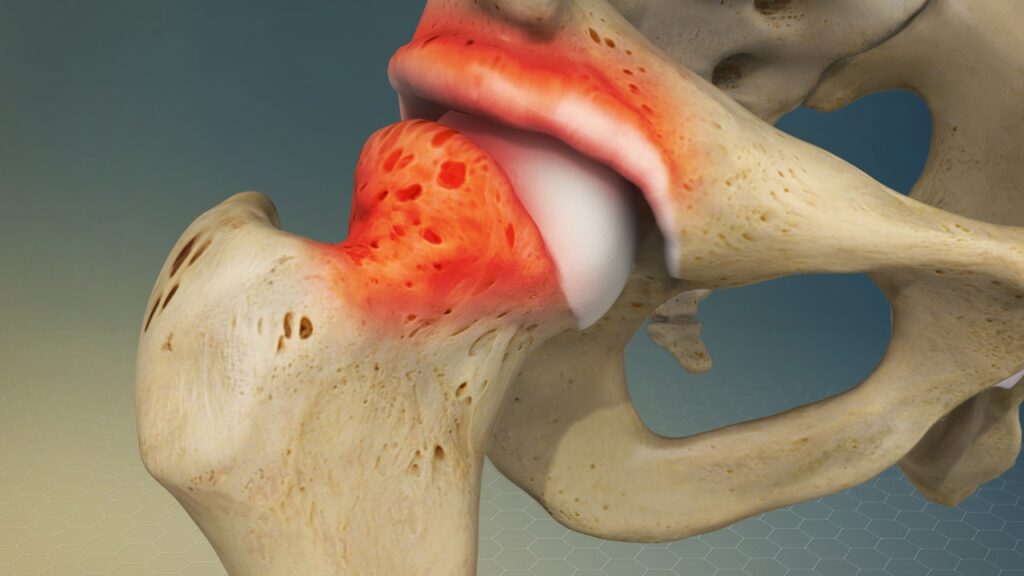
Image Source: https://www.hopkinsmedicine.org/health/conditions-and-diseases/hip-impingement
If you’d like support in dealing with Hip Impingement you can join my FREE 5 Day Hip and Lower Back Treatment Plan or get 1:1 support with our recovery plans.
My Journey with FAI
I underwent surgery for FAI in September 2013, after seven long years of persistent hip pain. The road to diagnosis was anything but straightforward—I bounced between my GP, multiple physiotherapists, and finally a consultant who understood what was really going on. This period of uncertainty was incredibly frustrating. At one point, a physiotherapist asked me if the pain was “all in my head,” which was intimidating and frustrating to hear, when all I was doing was asking for help! As a young, fit, and active woman, it was perhaps difficult to understand how I was even in any pain or how I could push past the pain? But when you’re told there is nothing wrong and keep doing what you’re doing, you follow the professional advice, right?! I was desperate for answers and some relief from the constant discomfort that had become a part of my daily life. A defining moment before surgery was a trip to Paris and I had to stick my fingers in my hip to relieve the pain as I walked around the city.
Femoroacetabular Impingement is often diagnosed in athletes or those who are very active, but it can affect anyone, regardless of their activity level.
Types of Hip Impingement
There are two main types of FAI: cam and pincer.
- Cam Impingement: This occurs when the femoral head is not perfectly round, which means it doesn’t rotate smoothly inside the acetabulum. This can cause the labrum to become pinched and the cartilage to wear away over time.
- Pincer Impingement: This type happens when the acetabulum covers too much of the femoral head, causing the labrum to be pinched between the bones.
In some cases, people can have a combination of both cam and pincer impingement.
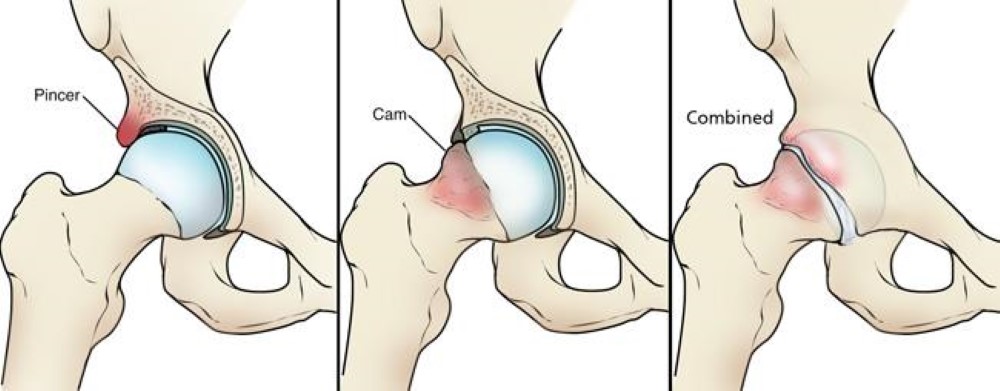
Image Source: https://orthoinfo.aaos.org/en/diseases–conditions/femoroacetabular-impingement/
What causes Femoroacetabular Impingement?
Everybody is different, sometimes it’s just the way you are born, other times it can be an accident that has caused the damage possibly through sports.
The causes of FAI can vary widely. For some, it’s simply a matter of genetics—the way their bones developed over time. For others, it might be the result of an injury or repetitive stress on the hip joint, often seen in sports that require a lot of hip rotation like football, hockey, or dance. In my case, I suspect it was a combination of a previous injury where I fractured my coccyx playing football, then without any treatment to help realign the body and promote healing and recovery I continued with regular high-impact activities.
Symptoms of Hip Impingement
The symptoms of FAI can range from mild discomfort to severe pain that impacts daily activities. Here are some of the common signs:
- Pain in the hip and groin area, especially after prolonged sitting or physical activity.
- A reduced range of motion in the hip joint, making it difficult to perform activities like putting on socks or shoes.
- A pinching sensation in the hip, particularly during movements that involve hip flexion.
- Pain that gets worse after exercise, especially activities that involve a lot of hip movement.
- The pain is often felt deep within the hip joint, along the front of the groin, and can sometimes radiate to the thigh or buttocks.
- Limited movement, particularly with internal rotation of the hip, such as crossing your legs.
Femoroacetabular Impingement Diagnosis
Diagnosing FAI can be a bit of a journey, as I personally experienced. It often begins with a physical examination, where your doctor will assess your range of motion and pinpoint where the pain is coming from. From there, imaging tests like X-rays or MRIs (sometimes with contrast to enhance the image of the cartilage in the hip.) are commonly used to get a clearer picture of what’s happening inside your hip. These images help in identifying whether there is any abnormal bone growth, damage to the labrum, or other issues within the joint.
Femoroacetabular Impingement Treatment
If you visit your GP or Physiotherpist, treatment for FAI typically starts with less invasive options, such as:
- Physiotherapy: To help strengthening the muscles around the hip to support the joint and improve mobility. I spent a lot of time with various physiotherapists, working on exercises to manage the pain and keep my hip as functional as possible.
- Medication: Anti-inflammatory drugs or pain relievers can help manage symptoms, especially during flare-ups. I relied on painkillers way too much!
- Activity Modification: This involves changing the way you move to avoid activities that aggravate the hip.
- Injections: Corticosteroid injections may be used to reduce inflammation and provide temporary relief.
If you visit me for treatment (I often work in a complimentary manner with clients who are also seeing their physiotherapist and consultant) I’ll share all the things that worked for me. Unfortunately the above treatments provided me with very little relief.
- Kinetic Chain Release (KCR) – I tried almost every type of treatment out there looking for relief and KCR was the one treatment that gave me more relief than anything else. If you’re local you can book a treatment.
- Yoga – while there is debate around whether yoga is suitable for people with hip impingement, the concerns people have are referring to pushing your body into a position to get into an advanced yoga posture. To me that’s ot yoga. In my experience yoga can benefit hip impingement by developing strength, stability in the hip joint, core and spine. But also provides a mindful approach, a whole mind body spirit approach to your healing and recovery. During my diagnosis was when I truly embodied all the other elements of yoga beyond the postures from meditation to breathwork, to the yamas and niyamas.
- Yoga Nidra – This is a practice of yoga that helps the body to deeply rest. Essential when you’re in pain and having trouble sleeping.
- Ayurveda – Ayurveda is Yogas sister science and looks at the unique physiological and psychological qualities of a person. Ayurveda teaches simple daily routines for the longevity of you health such as tongue scraping and self massage along with dietary adjustment. After having FAI I started exploring nutrition for healing and managing pain. This is when I really started to embrace Ayurveda and now like yoga it’s become who I am and how I live my life. It’s a guide for life no matter what stage of life you’re in.
For me, surgery became the last resort after exhausting these options. But I don’t regret it for a second—it significantly improved my quality of life. The surgery, known as hip arthroscopy, involved reshaping the bones to fit together more naturally and repairing the damaged labrum.
Femoroacetabular Impingement Surgery Recovery
Unfortunately the recovery process was longer and more challenging than I anticipated, and it required a lot of patience. Everyone’s experience with recovery is different, but for me, it was a journey that tested my resilience. I had to relearn how to trust my body and take things slowly. In the end, though, I’m grateful for the experience—it taught me to listen to my body, understand the difference between pain and sensation and appreciate every small step towards improvement. Today, I’m stronger for it, both physically and mentally and my whole life has changed.
If you’d like support in dealing with Hip Impingement I have a Hip and Lower Back Recovery Program (there are options for if you’re local or for anywhere in the world) knowing you’re not alone can make a big difference. I wish I’d known someone like me now who’d been through it and can offer wisdom, guidance and support. Click here for more information, reach out on email or through Facebook or Instagram and send a DM if you have any questions or would like support.
Or if you’re ready to get going. JOIN our Hip Program here.